




It is born out of sign. Human creations, whatever those may be, never materialized from vacuum. Arts are creations resulted from a relational connection between passion and stimulants. This connection is usually called as signifying process and this process runs at a very internal level, in the aesthetic battle of the creator.
Philo Article Space is presenting paintings and sculpture in the theme of Urban Signs. The space and time or condition that we call ‘urban’ is certainly an internal process of specific signs of all the parties involved in it, whether they are aware of it or not.
An artist has an ideal picture or concept of the art world in their mind (signified) and with all the sensory talent that they have, they capture the external signs (usually called signifier). It is this concept and the sensory talent that form the foundation of the knowledge (the signifying process) as a creation. Put simply, a creation is none other than a ‘system of signs’, not a mere idea or material.
A product, which in this context is an art work, as a ‘system of signs’ may only be understood through language. But we shall not see language in its narrow sense as a means to communicate, but to see it as a signifying (signifier – signified) process occurring in a self. To observe a creation of art is comparable to trying to read or interpreting the language of the creation, and in this effort to understand itself we are going through the signifying process, as we put meaning to the language of the creation. Our interpretation may arrive at the same meaning the creator invented, but it may as well be entirely different.
The exhibition under the theme Urban Signs is presenting the works of five artists, sculptors and painters. Painters are Priyaris Munandar, Joko ‘Gundul’ Sulistiono, Sujarwo, Deny Bojong, sculptor is Lenny Ratnasari Weichert. Each brings their own ‘language’ but all are united in their intention to convey their ‘readings’ of the phenomenon occurring in their daily life: the urban phenomenon.
The paintings of Priyaris Munandar show groups of human beings with erect objects in certain measurement. These groups do not form a random configuration, but they are in a formation that looks as if they are faced with a serious condition and that they are acutely aware of their own position. It is a realistic representation which reminds us that we are at all times in an alert-ready situation and that we may be at any times under threat. But the groups do not constantly explicitly separated, but mingle when it is obvious it is not possible to avoid it. Urban space is basically a competitive relational spirit!
The paintings of Joko ‘Gundul’ Sulistiono bring forward festivity that we often see in city murals. People are constantly moving forward, their mind focused on the way ahead, trapped in their own choices and surrounded by the products of modern technology, information, transportation, and many things. But by replacing the modern human with the archaic characters of the Punakawan, we are then perturbed by the question: are we mentally capable of dealing with such sophisticated environment?
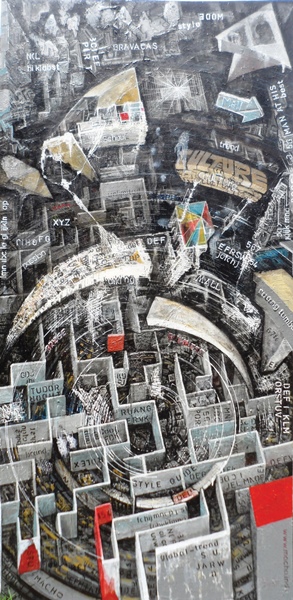
The above question may find its answer in the creations of Sujarwo which are presenting the optimism of today and the tomorrow. Our daily life is indeed a labyrinth, we trod without the assurance of finding a way out. It is in our urban disposition to strive to move forward, even upward reaching the sky, with the ambition of building our castle in heaven just as it was in the story of the ancient Babel tower.
But this optimism does not free us from the fact that humans, no matter how hard they try, are still walking with their feet on the ground. Their wing constructions are too fragile to enable them to fly to the sky as they are not yet settled their problem with the land they step on.
Lenny’s sculptures show figures of women still having trouble with their own existence. This is a phenomenon that cannot be freed from the history of women, especially on sexual relations. The long history of sexual relations or gender discrimination has provided its shares of women’s depression in ‘women’s fate’ related to their body. It is the body of women that gives life to life, but it is also the body that has been subjected to abuse and subjugation throughout history.
In contrast, Denny Bojong presents the idea that urban space is split into the marginal and the other. And in this marginal space there are male bodies that are hopeless, feeble, resigned, and complacent for the fate that would decent to their bodies. What causes this space divide? Of what victim is this? Returning to the beginning of our curatorial, looking at the optimism that Priyaris Munandar is infusing in his works, perhaps we find the answer that no matter what, competition would not end! There are many signs that propel the competition, but it seems that the urban space is concentrated and divided by the capitalist interest, as seen by the merriment and glimmer of its content.
Happy exhibiting!
Tommy F. Awuy
Curator
Artists:
Priyaris Munandar
Joko ‘Gundul’ Sulistiono
Sujarwo
Deny Bojong
Lenny Ratnasari Weichert
April 27 – May 27, 2013